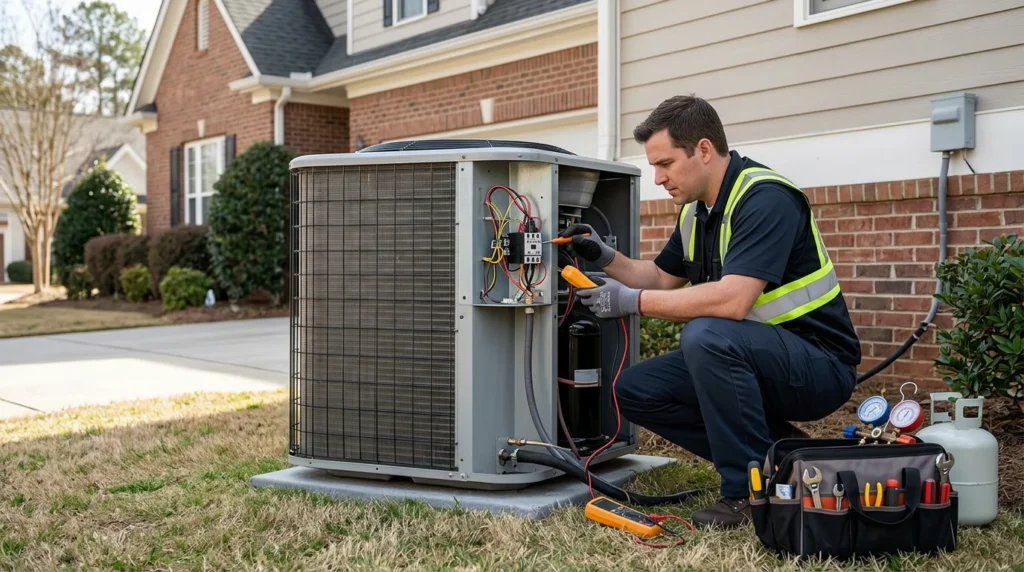
Quick answer: Call a local HVAC company that offers after-hours dispatch and can diagnose your system safely on-site. Shut the system off if you smell burning, see smoke, hear loud grinding, or the breaker keeps tripping. Have your thermostat settings, any error messages, and a brief timeline of what changed ready so the technician can prioritize the most likely causes and restore safe operation faster.
What Counts as an HVAC Emergency
An HVAC problem is an emergency when it creates a safety risk, could cause fast equipment damage, or leaves your home without workable temperature control during extreme weather. Common “call now” triggers include burning or electrical smells, smoke, repeated breaker trips, loud metal-on-metal noises, or water leaking fast enough to threaten ceilings or floors.
If you’re in Loganville and need emergency heat pump repair loganville ga, treat the first step as damage control: switch the system off at the thermostat, and if it’s tripping breakers or you smell electrical heat, turn it off at the breaker as well. Then wait for a technician rather than repeatedly restarting it, which can turn a manageable failure into a larger electrical or compressor-related issue.
Loss of cooling during a heat wave can also qualify as urgent, especially for infants, seniors, pets, or anyone with medical needs. If your system has a backup mode on the thermostat, use it only as a temporary bridge; it can keep you safe, but it may cost more to run and won’t fix the underlying problem.
Safety Escalation: When to Call 911, an Electrician, or Shut Off Power
Call 911 or your local fire department if you see active flames, heavy smoke, or you hear popping/crackling that suggests an active fire. Get everyone out first and don’t try to “save” the equipment.
Call an electrician if you see arcing at the electrical panel, smell burning at the panel, notice a hot breaker faceplate, or the breaker won’t reset and you’re not sure why. HVAC technicians can diagnose HVAC equipment, but panel issues and damaged branch wiring are electrician territory.
Shut the system off at the thermostat for most urgent symptoms. If you smell electrical burning, the unit keeps tripping the breaker, or you see water near electrical components, shut off power at the outdoor disconnect (if you can do so safely) and/or the breaker. Don’t open access panels or touch wiring.
Who to Call: A Quick Vetting Checklist
Use a few concrete questions to find the right company quickly, especially after hours. You’re trying to confirm they can respond fast, diagnose correctly, and handle common parts and refrigerant work without multiple return trips.
Ask: Do you offer after-hours dispatch and what’s the typical response window tonight? Do you service my equipment type and brand, and can you work with my thermostat/control system? Do you commonly carry parts like capacitors, contactors, blower components, and control boards on the truck? Can you handle refrigerant leaks and recharging on-site if that’s what the diagnosis indicates? Will you provide a written estimate before any major repair or part replacement?
What You Can Check Safely vs. What Requires a Technician
You can rule out a few simple issues without tools. Confirm the thermostat is set to the correct mode (COOL or AUTO) and that the setpoint is at least a couple degrees below the current indoor temperature. If your thermostat shows an error message, take a photo—messages can help a technician narrow down likely problem areas.
Check the air filter. A severely clogged filter can restrict airflow and can contribute to icing, shutdowns, or poor cooling. If it’s dirty, replace it and leave the system off for 30–60 minutes to see if any frost begins to melt. Also verify supply vents are open and return grilles aren’t blocked by furniture or rugs.
Outside, look at the outdoor unit from a safe distance. Clear leaves or debris from around it and make sure nothing is physically jammed in the fan. Don’t chip ice off the coil and don’t spray it with hot water; both can bend fins or damage components. If the unit is encased in ice, it can indicate an airflow or refrigerant issue, but confirming the cause requires gauges and temperature measurements.
Repeated breaker trips can indicate an electrical short, a failing motor/compressor, a bad capacitor, or wiring damage. A buzzing outdoor unit that won’t start can be consistent with a capacitor or contactor problem, but a technician needs to verify with electrical testing rather than guess. Water leaks can be as simple as a clogged condensate drain, but leaks near the air handler can also be tied to an iced coil thawing; a technician confirms this by checking airflow, coil condition, and refrigerant-related readings.
If you want local help, Billy Butler HVAC is a place to call for diagnosis and repair.