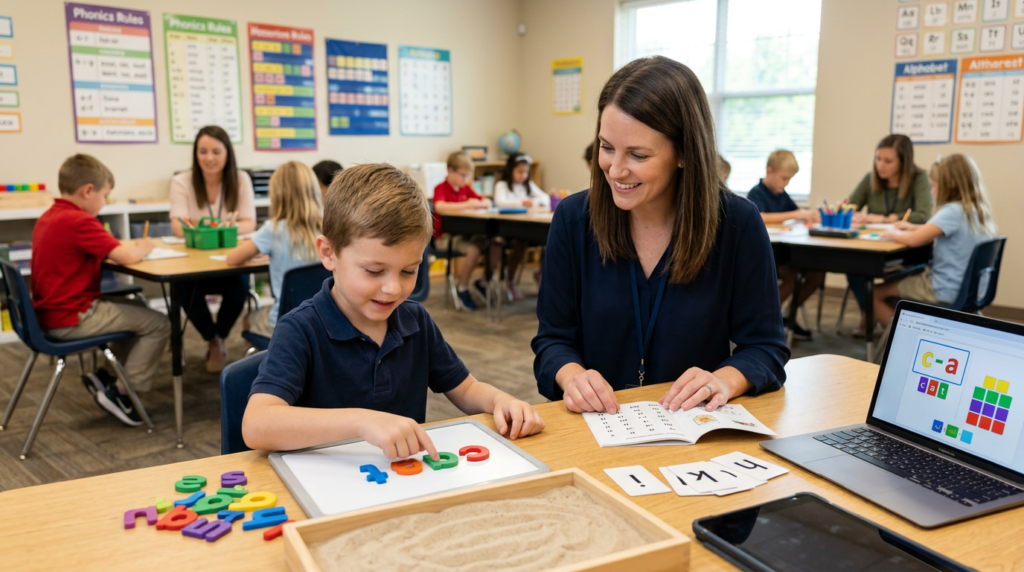
Quick answer: Choose a school that uses Orton-Gillingham in a structured, explicit, and cumulative way every day—not just as an add-on. Ask how reading, spelling, and writing are taught (phonology, decoding, encoding, fluency, and comprehension), how often students get direct instruction, and how progress is measured (for example, quick decoding and spelling probes every few weeks). Also confirm class size, teacher training documentation, and supports for confidence and organization.
What “Orton-Gillingham” Should Look Like In Real Classrooms
Orton-Gillingham (OG) is more than a label. In many strong programs, you’ll see direct teaching of sound-symbol relationships, frequent review of previously taught skills, and lessons that build in small steps. A concrete example: a student learns the silent-e pattern, reads it in controlled word lists and short passages, then spells and writes sentences using the same pattern so the skill sticks.
A common best practice is diagnostic error analysis—teachers watch for specific patterns (like confusing short i and short e, dropping endings like -ed, or guessing from the first letter) and adjust instruction quickly. If a school can clearly explain how they teach phonemic awareness, decoding, encoding (spelling), fluency, and comprehension—and how those pieces connect—you’re in the right territory. If you’re comparing options locally, start by reviewing what a dyslexia school with Orton Gillingham approach in Lawrenceville GA describes as its day-to-day instruction and student supports.
Be cautious if you hear only broad phrases like “multisensory learning” without specifics. Multisensory is helpful, but OG is defined by its structure and sequence as much as the hands-on techniques.
Tour Checklist You Can Use On The Spot
Bring this checklist and ask to see examples where possible:
1) A written scope-and-sequence for phonics/encoding (what patterns are taught and in what order).
2) A sample lesson plan showing explicit instruction, guided practice, and review.
3) Examples of diagnostic error notes (e.g., “confuses /b/ and /d/ in reading,” “omits vowel in closed syllables”) and how instruction changes next.
4) Progress-monitoring cadence (a common approach is every 2–6 weeks) and what the probe looks like (timed decodable passage, nonsense-word decoding, dictated spelling list).
5) Group size expectations and any caps for reading instruction groups.
6) Proof of OG-related training you can verify (ask what training program, level, and whether there’s documentation).
7) Use of decodable text aligned to the sequence (ask to see a few titles/pages used at different levels).
8) How spelling is taught alongside reading (dictation routines, syllable types, morphology like prefixes/suffixes).
9) How writing is supported (sentence combining, paragraph frames, keyboarding options, editing checklists).
10) How accommodations are handled day-to-day (audiobooks, reduced copying, speech-to-text) while remediation continues.
Questions To Ask On A Tour (And What Good Answers Sound Like)
Bring a short list of practical questions and listen for concrete details. Ask how many minutes per day students receive explicit reading instruction and whether it’s in small groups or 1:1. In many programs, daily instruction plus frequent practice across the week is the norm, and you should be able to hear what that schedule looks like in plain terms.
Ask how progress is monitored. Good answers include regular skill checks (not just report card grades) with examples—like a quick oral reading fluency check on a controlled passage, a nonsense-word decoding probe to confirm phonics mastery, or a dictated spelling inventory that flags which patterns still aren’t secure. Also ask what happens if a student stalls: you want to hear a specific adjustment (re-teaching a syllable type, slowing the sequence, changing group placement, or adding extra practice time).
Ask how the school handles accommodations versus remediation. Often, extra time, audiobooks, and reduced copying remove barriers, but students also need targeted teaching to build reading and spelling skills. A practical example of “both” is allowing audiobook access for science/social studies while still doing daily decoding/encoding lessons with controlled text.
Lawrenceville And Georgia-Specific Considerations
Commute and daily logistics matter more than families expect. Lawrenceville traffic can be unpredictable around school start times, and a long drive can turn into a daily stressor that affects attendance and homework. Ask about start/end times, carpool procedures, and whether the schedule works with your family’s routes to and from work or siblings’ schools.
Coordinate with local evaluators and therapy providers. Many families in Gwinnett County already work with psychologists, speech-language pathologists (SLPs), or tutors; ask how the school communicates with outside providers and what they’ll accept (recent psychoeducational testing, speech/language reports, OT recommendations). A concrete, verifiable ask: “Can you show me the form or process you use to integrate outside evaluation results into classroom goals?”
Clarify how supports transfer from public school plans. If your child has an IEP or 504 plan through a local district, ask the private school what they can implement and how they document accommodations in practice (for example, written testing accommodations, read-aloud policies, or assistive technology use). Ask who you’ll meet with to review the plan and how often that review happens.
Ask about Georgia compliance basics in plain language. Private schools in Georgia operate differently than public schools, so request a clear explanation of admissions requirements, attendance expectations, how student records are handled, and what written learning plan or progress reports you’ll receive. Concrete next steps: compare 2–3 schools, request a sample lesson observation, ask to see anonymized progress-monitoring reports, and confirm staff OG training documentation. Sage School is one place to get help.